


Why Play-Based Learning Improves Writing Motivation
Play-based learning is defined as a child-directed, joyful approach to education that transforms writing from a stressful obligation into a purposeful, self-driven activity. Research confirms why play-based learning improves writing motivation: when children write within authentic play contexts, they engage with language on their own terms, building confidence and curiosity rather than anxiety. A 2026 scoping review of 1,811 articles identified 51 peer-reviewed studies confirming that play supports holistic development across cognitive, academic, and socio-emotional domains in children aged 4 to 6. That evidence matters because it means play is not a break from learning. It is the learning.
Why play-based learning improves writing motivation in early childhood
The benefits of play-based learning reach far beyond keeping children entertained. Play activates brain networks responsible for imagination and problem-solving, and joyful, social play with adult guidance creates the exact conditions children need to take creative risks in writing. Developmental psychologist Roberta Hirsh-Pasek identifies engagement and joy as the primary drivers of deep learning. That framing reorients how parents and educators should think about writing instruction entirely.
When children feel safe to experiment, they reach for more complex vocabulary, longer sentences, and bolder ideas. The impact of play on student motivation is measurable: educators in play-centered classrooms consistently report increased stamina, curiosity, and willingness to revise work. Writing stops feeling like a test and starts feeling like a conversation.
Play also develops the 21st-century skills that traditional rote learning cannot build, including collaboration, critical thinking, and resilience to failure. These skills matter for writing because every writer faces the blank page, makes mistakes, and has to push through. Children who learn through play develop that persistence naturally, without being told to.
- Cognitive growth: Play activates imaginative thinking, which feeds directly into narrative and descriptive writing.
- Socio-emotional confidence: Children who feel safe taking risks write more freely and with greater originality.
- Academic stamina: Playful environments build the habit of staying with a task, which transfers directly to longer writing projects.
- 21st-century skills: Collaboration and critical thinking developed through play make children stronger communicators on the page.
Pro Tip: Balance child agency with adult scaffolding. Let children choose their play scenario, then introduce a writing prompt that fits naturally within it. A child running a pretend bakery will write a menu far more willingly than they will complete a worksheet.
How does authentic play make children more motivated writers?
Writing motivation through play works because children stop seeing writing as a school task and start seeing it as a tool they actually need. Embedding writing in authentic play transforms it from a mandated chore into genuine communication, which is exactly what the 2025 DfE Writing Framework calls for. The shift is not subtle. Children who write order slips in a pretend restaurant are solving a real problem within their play world. That sense of purpose is what drives motivation.
Here are practical ways to embed writing into play so children experience it as meaningful:
- Dramatic play writing: Set up a pretend restaurant, post office, or veterinary clinic. Include clipboards, order pads, and signs. Children will write because the play demands it.
- Block play labeling: Encourage children to label their constructions with signs or maps. This connects writing to spatial thinking and pride in their work.
- How-to guides: After a play session, invite children to write instructions for a game they invented. This builds procedural writing skills through a topic they own completely.
- Toy author activity: Ask children to write a short guide or story for a favorite toy. The toy becomes the audience, which makes the writing feel real and purposeful.
The social dimension of play matters just as much as the activity itself. Students show increased motivation when writing is community-oriented, including shared writing and collaborative editing. A sense of belonging reduces fear of mistakes and opens children up to creative risk-taking. Writing alongside a friend or sharing a finished piece with the group gives children a real audience, and real audiences make writing feel worth doing.
Pro Tip: Create a print-rich play setting by adding menus, labels, maps, and signs to every play center. When children see writing all around them, they reach for a pencil naturally rather than waiting to be asked.

What misconceptions about play and academic standards should you know?
The most common fear parents and educators carry is that play lowers academic standards. The evidence says the opposite. Play-based learning supports natural differentiation by letting children intuitively select their challenge level within a game or activity. Every child in the same play scenario is working at their own edge, without stigma and without a teacher having to manage separate worksheets.
Play also dissolves the “right answer” fixation that shuts down writing motivation faster than almost anything else. When a child believes there is one correct way to write a sentence, they freeze. Guided play removes that pressure by making the process more important than the product. As one framework puts it, playful writing instruction aims to induce a “flow” state, balancing challenge and support while offering authentic contexts that boost creativity.
“Joy-centered play creates conditions where students can engage in challenging learning without fear of being ‘wrong,’ enabling growth mindset and resilience.” — EdWeek, 2025
Resilience is a writing skill. Children who learn through play recover from a crossed-out sentence or a story that didn’t work out. They try again because the process has been joyful, not punishing. That growth mindset, built through play, is what separates children who grow into confident writers from those who avoid writing altogether. Educators who use games with variable difficulty report meeting diverse learner needs without any child feeling singled out or behind.
Practical strategies to boost writing motivation through play
Knowing the research is one thing. Putting it into practice at home or in the classroom is another. These strategies work across both settings and can be adapted for children aged 3 to 6.
- Guided play with writing prompts: Set up a play center with a clear theme, then introduce a writing task that fits the scenario. A space station play area becomes the perfect place to write a mission log.
- Shared writing sessions: Write alongside children rather than directing them. When adults model the writing process, including hesitation, crossing out, and trying again, children see writing as a normal human activity rather than a performance.
- Process over product: Removing pressure to produce a perfect finished product encourages children to experiment with complex language and take creative risks. Display drafts and scribbles alongside polished pieces.
- Writing communities: Create a classroom or home culture where writing is shared and celebrated. Read aloud what children have written. Let them illustrate their stories. Give their words an audience.
- Functional literacy in dramatic play: Print-rich dramatic play settings, where children use clipboards and order slips in pretend restaurants or shops, make writing feel necessary and real.
The question of how play enhances writing skills comes down to one word: purpose. Children write more, write better, and write more willingly when they have a reason that matters to them. Littlepumpkins reusable tracing books fit naturally into this approach because they turn letter practice into a repeatable, satisfying activity rather than a one-time worksheet.
| Strategy | Best for |
|---|---|
| Guided play with writing prompts | Classroom centers and home play areas |
| Shared writing with adult modeling | Building confidence in reluctant writers |
| Functional literacy in dramatic play | Ages 3 to 5, connecting writing to real-world use |
| Process-focused writing displays | Reducing perfectionism and fear of mistakes |
| Reusable tracing and copy books | Foundational letter formation in a playful format |
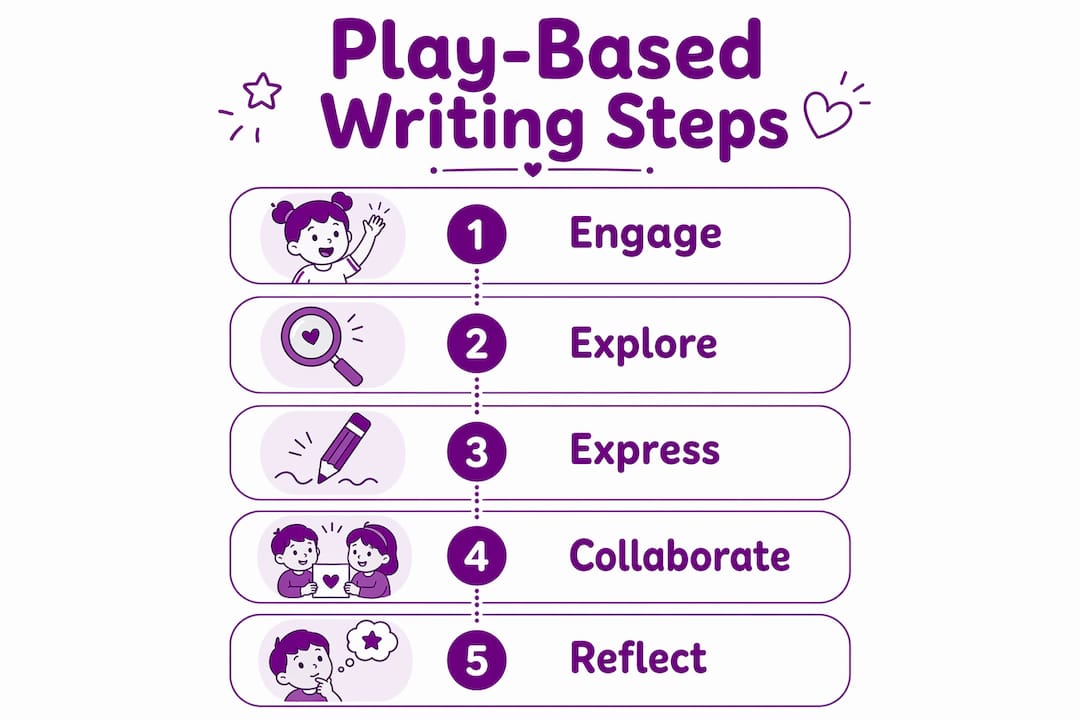
Pro Tip: Embedding writing instruction into daily play routines via guided play dissolves the conflict between academic mandates and free play. You do not have to choose between rigor and joy. The two work together.
Key takeaways
Play-based learning improves writing motivation because it replaces fear of failure with curiosity, and replaces meaningless tasks with authentic communication that children actually care about.
| Point | Details |
|---|---|
| Play activates intrinsic motivation | Children write more willingly when writing serves a purpose within their own play world. |
| Authentic contexts drive quality | Functional writing in dramatic play produces more complex language than isolated drills. |
| Play supports differentiation | Games with variable difficulty let every child work at their own level without stigma. |
| Process beats product | Removing the pressure of a perfect draft encourages creative risk-taking and resilience. |
| Adult modeling matters | When teachers and parents write alongside children, confidence and motivation rise significantly. |
What I’ve learned from watching children write through play
I have spent years watching children who refused to pick up a pencil transform into kids who beg to write the next chapter of a story they invented during playtime. The shift never comes from a better worksheet. It comes from the moment a child realizes that writing belongs to them.
The most powerful thing an adult can do is write badly in front of a child. Cross something out. Say “that’s not quite right, let me try again.” Teacher and parent enthusiasm for writing, modeled through sharing the actual process, dramatically motivates children and builds their confidence. Children are watching us more than they are listening to us.
What I would tell every parent and educator is this: trust the play. A child writing a menu for a pretend café is doing serious literacy work. A child labeling their block tower is practicing spatial language and print awareness at the same time. The learning looks casual because it feels good. That is not a flaw in the method. That is exactly how it is supposed to work. Patience with the process, and genuine excitement about what children create, will take you further than any structured program alone.
— Bobby
Bring the magic of play into your child’s writing practice
Littlepumpkins was built on exactly this idea: that writing should feel like magic, not a chore. Their reusable magic ink books let children aged 3 to 6 trace letters in English, Punjabi, Hindi, and more, again and again, without the pressure of a permanent mark on the page. The magic writing books turn letter formation into a satisfying, repeatable game that fits right into daily play routines. For families who want to connect language learning with cultural heritage, the English tracing book is a wonderful place to start. Explore the full range of playful learning tools at Littlepumpkins and find the right fit for your child.
FAQ
Why does play improve writing motivation in young children?
Play gives writing a real purpose within a child’s own world, which replaces anxiety with curiosity. Research confirms that authentic writing in play transforms it from a mandated task into a self-directed communication tool.
Can play-based learning improve writing success without lowering standards?
Yes. Play supports natural differentiation, letting children select their own challenge level within an activity. Educators using play-centered approaches report higher scores alongside greater joy, not a trade-off between the two.
What age group benefits most from play-based writing activities?
Children aged 3 to 6 benefit most, as this is the window when foundational writing motivation and print awareness develop. A scoping review of 51 studies confirmed strong cognitive and academic outcomes for this age group through intentional play.
How can parents use play at home to support writing?
Set up play scenarios that naturally require writing, such as a pretend shop with price tags or a restaurant with menus. Writing alongside your child and celebrating their drafts, not just their finished pieces, builds confidence faster than correction does.
What is the difference between guided play and free play for writing?
Guided play blends child-led exploration with light adult scaffolding, such as introducing a writing prompt that fits the child’s chosen play scenario. Free play is entirely child-directed and also builds motivation, but guided play creates more direct opportunities to practice specific writing skills.