


How Illustrations Shape Children's Book Learning
Illustrations in children’s books are defined as visual elements that actively support comprehension and language development by connecting visual and verbal information. They are not decoration. A meta-analysis of 20 studies involving 2,145 children confirmed that picture book illustrations significantly enhance early literacy, language, and vocabulary development, with a moderate effect size of Hedges’ g=0.71. That finding means the role of illustrations in children’s book learning is measurable, consistent, and strong enough to guide how parents and educators choose and use books every day. The field calls this “picture book literacy,” and understanding it changes how you read aloud tonight.
How do illustrations guide children’s attention and comprehension?
Children do not read a picture book the way adults read a newspaper. Eye-tracking research shows children fixate on illustrations first during picture-book reading, before they process any text. This “image-first” pattern is not a distraction. It is the brain’s natural entry point into the story.
The placement, size, and visual prominence of an image directly influence what a child understands. A large illustration of a frightened rabbit placed on the left page draws the eye before the text on the right explains why the rabbit is scared. That sequence primes comprehension. The child already has an emotional frame before a single word is decoded.
Effective illustration layouts use this behavior deliberately. Books like those in the Caldecott Medal tradition place key narrative moments in full-bleed spreads precisely because size signals importance to young readers. Smaller, inset images work for supporting details. The visual hierarchy teaches children how to prioritize story information.
- Prominence matters. Larger images receive longer fixation times and stronger comprehension links.
- Placement guides sequence. Left-page images prime understanding of right-page text.
- Salience signals emotion. Bright colors and high contrast draw attention to emotionally significant moments.
- Repetition reinforces meaning. Images that echo text vocabulary help children connect spoken words to visual referents.
Pro Tip: During read-alouds, point to the illustration before reading the page text. This aligns with children’s natural image-first attention pattern and primes comprehension before the words arrive.
What types of illustrations work best for different learners?
Not every illustration works equally well for every child. Research on proficiency-dependent comprehension identifies three main illustration types, and matching the right type to a child’s language level is the single most important factor in whether an image helps or hinders learning.

The three types break down clearly:
| Illustration type | What it shows | Best for |
|---|---|---|
| Representational | Direct, literal depiction of story objects or characters | Low proficiency learners, ages 3–5 |
| Explanatory | Shows relationships, sequences, or cause and effect | Intermediate learners building comprehension |
| Transformational | Abstract, metaphorical, or emotionally layered imagery | Higher proficiency readers with strong verbal skills |
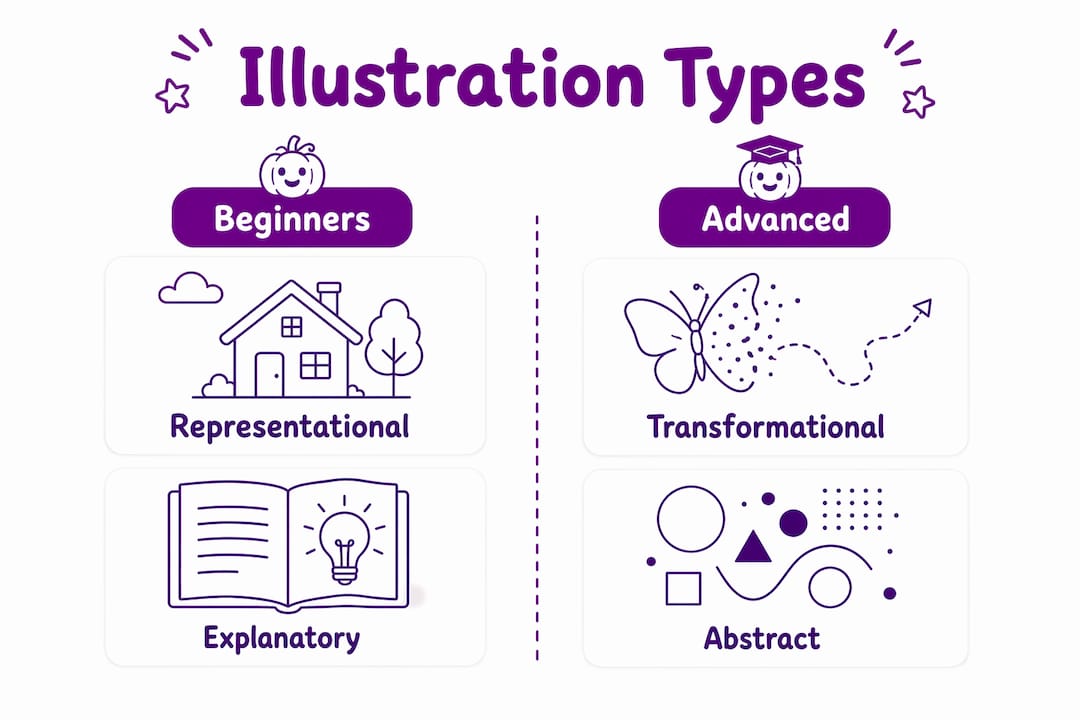
Representational images work for beginners because they reduce cognitive load. A child learning Hindi or Punjabi as a heritage language sees a picture of a mango and hears the word. The image carries the meaning directly. No inference is required.
Explanatory illustrations add a layer. They might show a character walking to school, then arriving late, then looking worried. The sequence teaches cause and effect without requiring the child to hold complex grammar in working memory. This type suits children who already recognize basic vocabulary and are ready to build narrative understanding.
Transformational illustrations can actually increase cognitive load for beginners. A swirling abstract image meant to convey loneliness requires the child to already know what loneliness feels like and how to connect that feeling to a visual metaphor. That is a high bar for a four-year-old still acquiring vocabulary. Cognitive load research confirms that complex images overwhelm low-proficiency learners while benefiting higher-proficiency children.
Pro Tip: When selecting books for a bilingual child just starting to learn a second language, choose books where the illustrations are representational and literal. Save the beautifully abstract picture books for when their vocabulary base is stronger.
How do color and emotional cues affect story understanding?
Color in children’s book illustrations is not a stylistic choice. A systematic review establishes that color functions as a multimodal narrative device, shaping emotional tone and providing interpretive cues that directly influence comprehension. That means the warm amber palette in a bedtime story is doing real cognitive work.
Children read color before they read words. A page that shifts from bright yellows to deep blues signals a mood change. That signal helps a child interpret the story even when the vocabulary is unfamiliar. For multilingual learners especially, color cues provide a comprehension scaffold that language alone cannot.
- Warm colors (red, orange, yellow) signal energy, excitement, or danger.
- Cool colors (blue, green, purple) signal calm, sadness, or mystery.
- High contrast draws attention to the most important story element on the page.
- Muted palettes often indicate memory, dreams, or emotional distance.
Illustrators like Shaun Tan in The Arrival use color shifts across entire sequences to carry narrative weight that the wordless format cannot express verbally. Even in books with text, color does interpretive work that words alone do not replicate. Parents and educators who point out color changes during reading give children a tool for emotional comprehension that transfers across books and languages.
Do illustrations help children learn, or just keep them engaged?
This is the most common misconception parents and educators hold. The answer is: both, but in different ways, and the distinction matters. A study with 52 language learners found that decorative pictures raise learner motivation consistently across all illustration types. Comprehension gains, however, depend on whether the image is meaning-making or merely decorative.
A decorative image of a smiling sun in the corner of a page about counting apples raises a child’s willingness to sit with the book. That is genuinely valuable. But it does not help the child understand counting. A meaning-making image that shows five apples arranged clearly on a tree does both: it motivates and it teaches.
The practical implication is that you need both types in a reading session, but you should know which one you are using and why.
- Use decorative images to build positive associations with books and reading time.
- Use meaning-making images when your goal is vocabulary, comprehension, or concept learning.
- Avoid cognitive overload by not selecting books where every page is visually dense with competing elements.
- Match image purpose to your session goal. Bedtime reading can lean decorative. Focused learning sessions need purposeful visuals.
Pro Tip: Before buying a new book, flip through it and ask: does each illustration connect directly to the text, or is it filling space? Books where images and words work together produce stronger comprehension outcomes.
Practical strategies for using illustrated books in early language learning
Parents and educators can use the research on visual aids in early literacy to make every read-aloud session more effective. The strategies below work for monolingual children and are especially powerful for multilingual learners building vocabulary in a heritage language.
Visual supports like maps and graphic schemata help children with diverse language backgrounds understand complex ideas and increase both motivation and participation. You do not need special materials. A simple drawing of the story’s setting before reading begins gives every child a visual anchor.
A step-by-step read-aloud approach for illustrated books:
- Preview the cover illustration. Ask the child what they see, not what they think will happen. Ground the conversation in the visual.
- Point to key images before reading each page. Name what you see using simple, clear language. For bilingual books, name it in both languages.
- Connect image to text. After reading the page, point back to the illustration and link one key word to what the image shows.
- Ask image-based questions. “What does the character’s face tell you?” builds emotional comprehension without requiring advanced vocabulary.
- Use the illustration to review. After finishing the book, flip back through the images and retell the story using only the pictures. This builds narrative sequencing skills.
- Adapt for proficiency. For beginners, stay with representational images and simple naming. For more advanced learners, use explanatory images to discuss cause and effect.
Matching illustration complexity to a child’s language proficiency level is the clearest way to prevent frustration and keep engagement high. For children learning Punjabi or Hindi alongside English, illustrated books that pair familiar visual contexts with new vocabulary reduce the gap between what a child can see and what they can say.
Illustrated books that build vocabulary work best when adults actively mediate the connection between image and word. Passive exposure to pictures produces smaller gains than guided, interactive reading where an adult names, points, and questions.
Key takeaways
Illustrations are active learning tools, not background decoration. When matched to a child’s proficiency and used with intentional read-aloud strategies, they produce measurable gains in vocabulary, comprehension, and motivation.
| Point | Details |
|---|---|
| Illustrations improve literacy outcomes | A meta-analysis of 2,145 children confirmed a moderate, measurable effect on vocabulary and comprehension. |
| Image-first attention is natural | Children fixate on illustrations before text, so pointing to images first during read-alouds primes understanding. |
| Match illustration type to proficiency | Representational images suit beginners; explanatory and transformational images suit more advanced learners. |
| Color carries meaning | Color functions as a narrative device that shapes emotional tone and supports story interpretation. |
| Motivation and comprehension differ | Decorative images build engagement; meaning-making images build understanding. Use both intentionally. |
What I’ve learned from watching children read with pictures
Bobby here. After years of watching children interact with illustrated books, one thing stands out clearly: most adults underuse the illustrations. They read the words and treat the pictures as a reward for sitting still. That is the wrong approach, and the research confirms it.
The most effective readers I have seen, both children and the adults reading with them, treat every illustration as a conversation starter. They pause. They point. They ask “what do you notice?” before they say a single word of text. That simple habit changes everything about how a child processes the story.
The other mistake I see often is choosing books based on how beautiful the illustrations are rather than how well they match the child’s language level. A stunning, abstract watercolor spread is a joy for an adult. For a three-year-old learning their first words in Hindi, it is confusing. Clear, literal, representational images are the right starting point. Beauty can come later, when the vocabulary is there to support it.
My honest advice: treat illustrations as the primary teaching tool and the text as the explanation. That is how young children actually experience picture books. Work with their natural attention, not against it.
— Bobby
Littlepumpkins storybooks: where illustrations meet real learning
Littlepumpkins designs its storybooks for kids with exactly this research in mind. Each book pairs clear, purposeful illustrations with text in English, Hindi, and Punjabi, giving children the visual anchors they need to build vocabulary in multiple languages at once.
For families who want to go beyond reading and into writing, Littlepumpkins’ writing books for kids combine illustrated letter guides with reusable magic ink tracing, so children practice letter formation while the illustrations keep them engaged. The visual and the written work together, one magical letter at a time. Browse the full range of learning tools at Littlepumpkins and find the right illustrated book for where your child is right now.
FAQ
What is the role of illustrations in children’s book learning?
Illustrations actively support comprehension and vocabulary development by connecting visual and verbal information. A meta-analysis of 2,145 children found a moderate positive effect on literacy outcomes from picture book illustrations.
Do illustrations help children learn new vocabulary?
Yes. When adults point to illustrations and name what they show, children build stronger word-to-meaning connections. This guided approach produces larger vocabulary gains than passive picture exposure alone.
Which illustration type works best for beginners?
Representational illustrations, which show literal, clear depictions of objects and characters, work best for low-proficiency learners. Proficiency-matched images reduce cognitive load and improve comprehension efficiency.
How does color in illustrations affect comprehension?
Color functions as a narrative device that shapes emotional tone and provides interpretive cues. Children use color shifts to understand mood changes and story events, even before they can decode the text.
Are illustrated books useful for bilingual children?
Illustrated books are especially effective for bilingual learners because visual context bridges the gap between languages. Visual supports like illustrations increase motivation and participation for children learning in a second or heritage language.