


Why Illustrated Books Aid Vocabulary Building in Kids
Illustrated books are the most effective early literacy tool for vocabulary development because they link words directly to meaningful images, giving children two pathways to understand and remember new language. This is the core reason why illustrated books aid vocabulary building so powerfully in children aged 3 to 6. Picture books, illustrated vocabulary journals, and storytelling resources all use visual cues to make abstract words concrete. When a child sees the word “leap” next to a drawing of a frog mid-jump, the meaning clicks instantly. Littlepumpkins builds on this exact principle, pairing rich illustrations with hands-on letter tracing to make language learning feel magical.
How do illustrations facilitate vocabulary acquisition in young children?
Illustrations work because of a concept researchers call dual-channel processing. The brain takes in visual information and verbal information through separate channels at the same time. When a picture and a word appear together, the child builds two mental representations of the same concept. That redundancy makes the word far easier to recall later.
Visual definitions of concrete nouns and action verbs are one of the clearest benefits of illustrated books. A picture of a dog teaches “dog.” A picture of a child running teaches “run” in a way that a printed word alone never could. This matters especially for verbs, because dynamic action illustrations help children grasp abstract verb meanings far more effectively than static images or text descriptions.
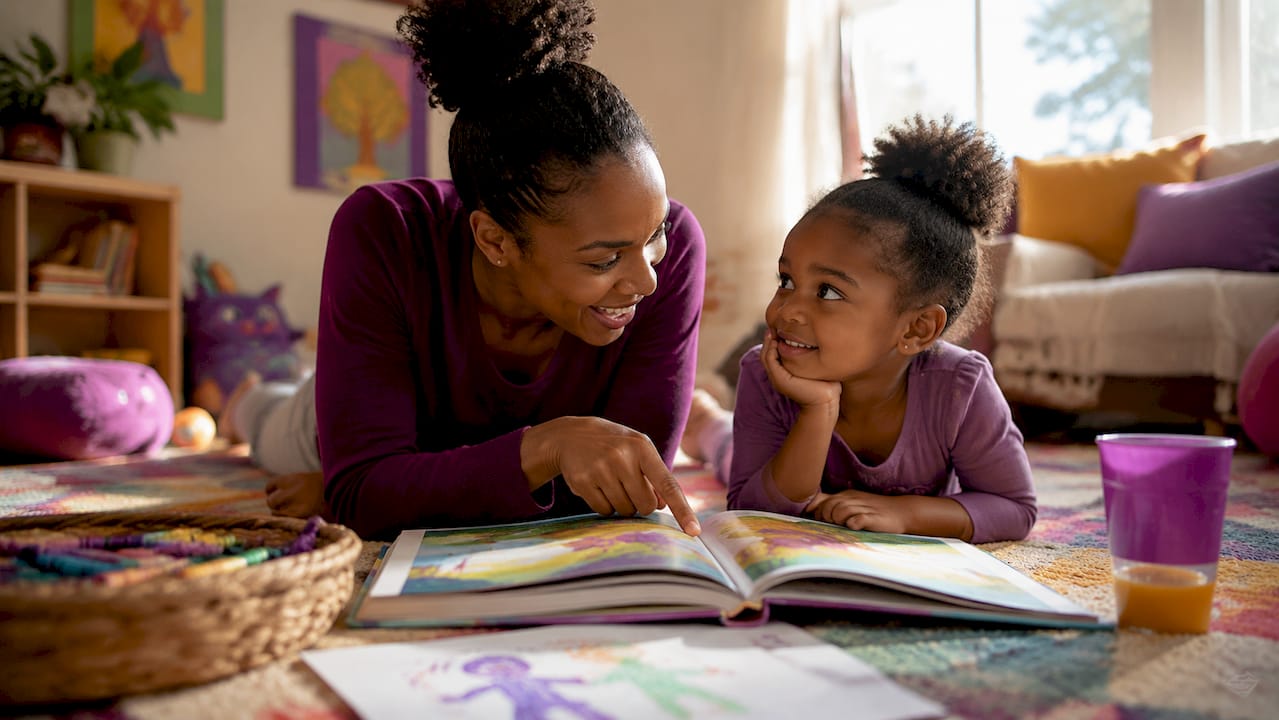
For language learners and early readers, illustrations serve an additional function. They provide redundant meaning that acts as a safety net. When a child misses the meaning of a word in the text, the picture fills the gap. This is especially valuable for bilingual children learning vocabulary in two languages at once.
Here is what that looks like in practice:
- Concrete nouns: A picture of an apple next to the word “apple” gives the child an instant, unambiguous definition.
- Action verbs: An illustration of a child jumping confirms the meaning of “jump” without any explanation needed.
- Descriptive adjectives: A bright red ball next to the word “red” teaches color vocabulary through direct visual association.
- Emotional vocabulary: A character with a wide smile teaches “happy” in a way that resonates emotionally, not just intellectually.
Pro Tip: When reading with your child, pause at each illustration and ask, “What is happening in this picture?” That one question activates both visual and verbal processing at the same time, doubling the learning opportunity.
What does research say about picture books and vocabulary development?
The evidence supporting the role of illustrated books in vocabulary instruction is strong and growing. A classroom intervention using picture storybooks with interactive activities raised mean vocabulary test scores from 63.75 to 80.83, with an N-Gain score of 47.11%. That is nearly a 27% improvement in raw scores from a single structured intervention. The gain shows that illustrated books do not just passively expose children to words. They actively accelerate mastery when used with intention.
Culturally relevant illustrations add another layer of effectiveness. A study on multilingual illustrated vocabulary resources integrating local wisdom found mean user evaluation scores between 4.80 and 4.93 out of 5. Content validity scores reached 1.00 and 0.86. Those numbers reflect near-perfect perceived usefulness among elementary students. Children engage more deeply when the images reflect their own cultural world.
Research on traditional culture-based picture books goes even further. A 2026 study found that a picture book intervention improved preschool children’s attention span, working memory capacity, and Stroop task response times. Vocabulary learning does not happen in isolation. It depends on the same cognitive systems that picture books strengthen.
“Combining storytelling with visual arts makes abstract vocabulary tangible and emotionally meaningful, fostering deeper retention.” — AAKollective educational resources
| Study focus | Key finding |
|---|---|
| Picture storybook intervention | Vocabulary scores rose from 63.75 to 80.83 (N-Gain: 47.11%) |
| Multilingual illustrated resources | User evaluation scores of 4.80–4.93 out of 5 |
| Traditional culture picture books | Improved attention, working memory, and cognitive processing |
| Storytelling with visual arts | Abstract words become emotionally anchored and easier to retain |
How do illustrated books compare to other vocabulary teaching tools?
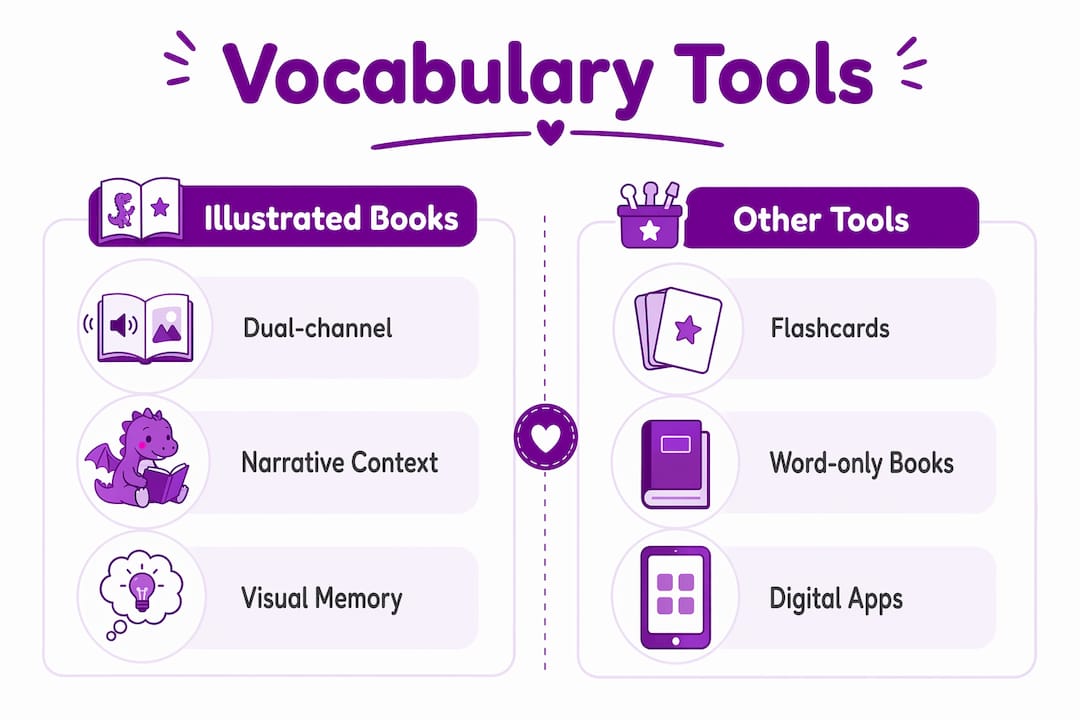
Flashcards, word-only books, and digital apps each have a role in vocabulary instruction. But illustrated books offer something those tools rarely deliver: narrative context combined with visual meaning. A flashcard shows a word and maybe a single image. An illustrated story book shows that word in action, surrounded by characters, emotions, and a plot that gives the word a reason to exist.
| Teaching tool | Strengths | Limitations |
|---|---|---|
| Illustrated books | Dual-channel processing, narrative context, emotional engagement | Requires adult guidance for maximum benefit |
| Flashcards | Fast repetition, portable | No context, rote memorization only |
| Word-only books | Builds decoding skills | No visual support for meaning-making |
| Digital apps | Interactive, self-paced | Screen fatigue, limited emotional depth |
The advantage for multilingual learners is especially clear. A child learning both English and Hindi benefits from seeing the same illustrated scene labeled in both languages. The image acts as a shared anchor. Neither language needs to be translated through the other. Both words connect directly to the visual meaning. This is why magic ink books vs. traditional workbooks for bilingual kids consistently show stronger engagement outcomes.
Storytelling combined with visuals also outperforms isolated vocabulary drills. When a child hears a story, they experience words in emotional and narrative context. That context creates memory anchors that drilling simply cannot replicate.
What strategies help parents and educators maximize vocabulary gains?
The benefits of illustrated books multiply when you move beyond passive reading. Here are five strategies that research and classroom practice support:
-
Draw vocabulary-inspired art. Ask your child to draw their own version of a word from the book. Creating art inspired by vocabulary words builds personal mental anchors that strengthen memory far more than viewing existing illustrations alone.
-
Keep an illustrated vocabulary journal. After reading, have your child paste or draw pictures of new words in a dedicated notebook. This word collector becomes a personalized reference they actually want to revisit.
-
Re-read and discuss images. Re-reading the same book three or four times is not repetitive. It is strategic. Each reading allows the child to notice new details in the illustrations and connect them to the words more deeply.
-
Add interactive elements. Supplementing picture books with word search puzzles or matching games increases vocabulary acquisition. Controlled classroom trials confirmed that combined activities outperform reading alone.
-
Choose culturally relevant books. Select books where the illustrations reflect your child’s heritage, community, or daily life. Children engage more deeply with images that feel familiar and meaningful.
Pro Tip: Use the early childhood learning materials guide from Littlepumpkins to identify age-appropriate illustrated books that match your child’s language background and developmental stage.
For educators, the most effective classroom approach pairs illustrated read-alouds with a brief art activity. Children who draw a scene from the story immediately after reading retain significantly more vocabulary than those who simply answer comprehension questions. The physical act of drawing forces the brain to reconstruct the image and the associated word from memory.
Key takeaways
Illustrated books build vocabulary faster than text-only tools because they give children two simultaneous pathways to meaning: the word and the image.
| Point | Details |
|---|---|
| Dual-channel learning | Images and words together create stronger, more lasting memory than either alone. |
| Research-backed gains | Vocabulary scores rose nearly 27% in one picture storybook intervention study. |
| Cultural relevance matters | Illustrations reflecting a child’s heritage increase engagement and perceived usefulness. |
| Active beats passive | Drawing vocabulary-inspired art after reading produces better retention than passive viewing. |
| Multilingual advantage | Illustrated books let bilingual children anchor words in both languages to a single visual meaning. |
Why I think we underestimate what a good illustration actually does
Most conversations about picture books focus on the story. The illustration gets treated as decoration. That framing misses the real mechanism at work.
I have spent years watching children interact with illustrated books, and the moment that always stands out is when a child points at a picture before they say the word. They see the meaning before they can express it. The illustration is not supporting the text. The illustration is the first language. The text comes second.
This matters most for children learning more than one language at once. When a child sees a picture of a grandmother cooking, that image carries cultural weight that no word in any language fully captures. The illustration does the work of ten vocabulary lessons in a single glance. That is why culturally grounded illustrations are not a nice-to-have. They are the whole point.
The research on traditional culture picture books improving working memory and attention span confirms what I have observed directly. A child who is emotionally connected to what they are reading pays closer attention. Closer attention means more words absorbed, more meanings retained, and more confidence to use new language.
The practical takeaway is simple. Do not choose a book because it has pictures. Choose it because the pictures tell a story the child recognizes as their own.
— Bobby
Explore Littlepumpkins’ illustrated learning tools
If you are looking for illustrated books that put these principles into practice, Littlepumpkins has built a collection designed specifically for children aged 3 to 6. Every resource combines rich, culturally meaningful illustrations with hands-on learning activities that turn vocabulary building into something children genuinely look forward to.
Browse the story books for kids to find illustrated titles that build vocabulary through narrative and visual context. Pair them with the drawing books for toddlers to give your child a creative outlet for the words they are learning. For families raising bilingual children, the writing books for kids add a tracing and handwriting layer that reinforces both the word and its written form. Each tool is designed to work together, making it easy to build a complete early literacy routine at home.
FAQ
Why do illustrated books help children learn new words?
Illustrated books pair words with images, giving children two simultaneous pathways to meaning through dual-channel processing. This makes new vocabulary easier to understand and remember than text alone.
Do illustrated books improve language skills for bilingual children?
Yes. Illustrations act as a shared visual anchor for words in two languages, so neither language needs to be translated through the other. Research on multilingual illustrated resources shows user evaluation scores of 4.80–4.93 out of 5 among elementary students.
How often should children re-read the same illustrated book?
Re-reading the same book three to four times is recommended. Each reading allows children to notice new details in the illustrations and build deeper connections between images and words.
What makes an illustrated book more effective than flashcards?
Illustrated books provide narrative and emotional context that flashcards cannot. Storytelling combined with visuals creates memory anchors, while flashcards rely on rote repetition without meaning.
At what age do illustrated books have the greatest vocabulary impact?
The benefits of illustrated books are strongest between ages 3 and 6, when children are in the most active phase of language acquisition and rely heavily on visual context to make sense of new words.