


Magic Ink Books vs. Traditional Workbooks for Bilingual Kids
Magic ink books are reusable writing practice tools that use disappearing ink technology to let children trace letters and numbers repeatedly without paper waste, making them a genuinely different category from traditional paper workbooks. When you compare magic ink books to traditional workbooks for teaching heritage languages like Punjabi or Hindi, the differences go far beyond format. Each tool shapes how a child feels about writing, how often they practice, and how quickly they build confidence. This article breaks down both options so you can choose the right fit for your child’s bilingual learning journey, or learn how to use both together for the best results.
How do magic ink books and traditional workbooks compare for bilingual learners?
Magic ink books and traditional workbooks each carry distinct strengths, and the gap between them becomes most visible when you are teaching a heritage language script to a child aged 3 to 6. Understanding what each tool does well is the fastest way to make a smart choice.
Magic ink books use a water-based or disappearing ink pen that fades within 20 to 30 minutes, allowing a child to trace the same page dozens of times. This is not just convenient. It removes the finality that makes young children freeze up when they pick up a pencil. Products like the Sank Magic Practice Copybook Set and CosyCorner Magic Ink Copybooks are built around this idea, and both have become popular choices for parents teaching scripts that feel unfamiliar to little hands.

Traditional workbooks, by contrast, are single-use paper books where every mark stays visible. Kumon and Brain Quest are well-known examples in this category. The child writes once, the page fills up, and the book is done. That permanence is both a limitation and a teaching tool, depending on what you need from the session.
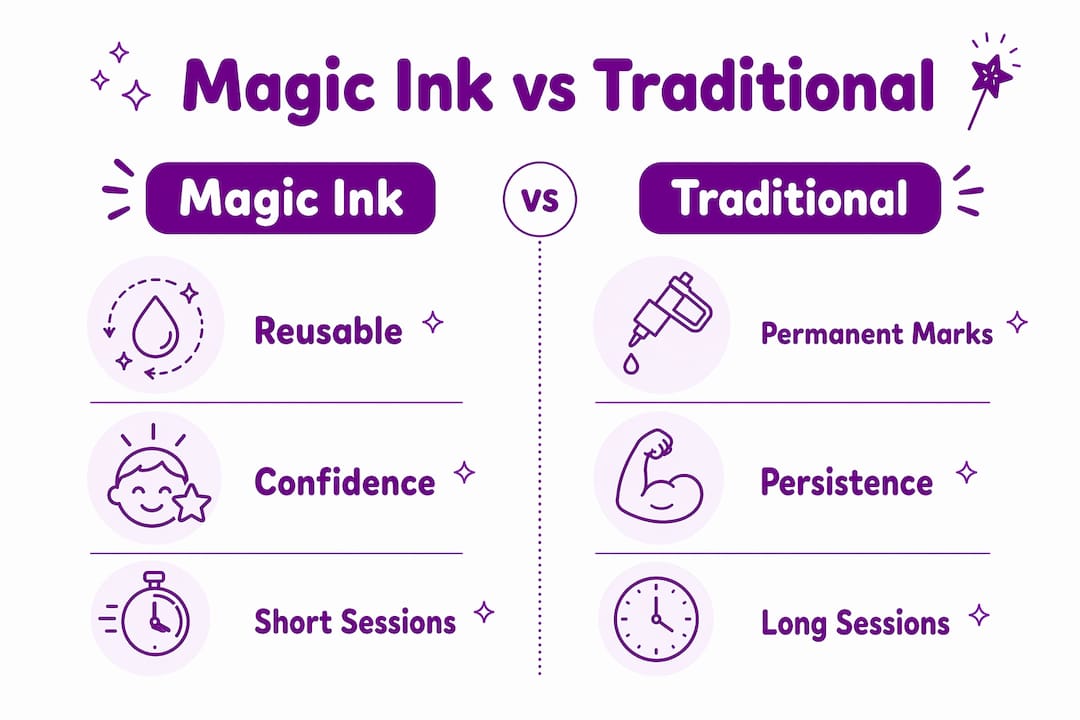
The core difference is this: magic ink books prioritize repetition and confidence, while traditional workbooks prioritize completion and accountability.
What are the advantages of magic ink books for bilingual children?
The biggest magic ink book benefit is psychological. Mistakes disappear, so a child who writes a Gurmukhi letter backward does not stare at the error for the rest of the session. Every reviewed magic ink set in 2025 and 2026 is described as “mistake-friendly” precisely because of this feature. For a child learning a script they rarely see outside the home, that freedom matters enormously.
Here is what makes interactive magic ink books stand out for heritage language learning:
- Reusability reduces cost and waste. One set of magic ink books replaces dozens of traditional workbook purchases over a year. The eco-friendly design also models values many families want to pass on alongside their language.
- Grooved templates build muscle memory. CosyCorner Magic Ink Copybooks feature 3D grooves that physically guide a child’s hand, developing fine motor skills the same way training wheels teach balance. This is especially useful for scripts with complex strokes.
- Multi-subject integration keeps sessions varied. The Sank Magic Practice Copybook Set includes four books covering alphabets, numbers, drawing, and math. Switching between subjects within one sitting holds attention longer than a single-subject drill.
- Confidence grows through repetition without judgment. When a child can practice the same letter ten times in one sitting and see only their best attempt, they associate writing with success rather than struggle.
Pro Tip: Set a timer for 20 minutes when your child starts tracing. When the ink begins to fade naturally, it signals a natural break point rather than an interruption, which keeps the session feeling playful rather than pressured.
The fear of permanent mistakes is one of the most underrated barriers to writing practice in young bilingual learners. Magic ink books remove that barrier entirely.
How do traditional workbooks support learning and discipline?
Traditional workbooks teach something magic ink books cannot: the experience of finishing something. Educators consistently emphasize that traditional workbooks build persistence because a child must complete an exercise fully before moving on. There is no reset button. That structure trains longer attention spans and a sense of accomplishment tied to visible progress.
For heritage language education, this matters when a child is ready to move beyond tracing and into independent writing. A traditional workbook page that shows a child’s improving Devanagari letters over several weeks is a record of growth. You can flip back, compare, and celebrate.
Traditional workbooks also offer:
- Static error visibility that allows structured correction. A parent or teacher can review a completed page and give specific feedback, which supports long-term progress tracking in ways disappearing ink cannot.
- Subject-specific focus that suits older or more advanced learners who need concentrated practice in one area, such as Hindi vowel matras or Punjabi conjunct consonants.
- Tangible proof of effort that children and parents can hold, display, and share with grandparents or extended family.
The limitations are real, though. Single-use pages mean a child who struggles with a letter gets one shot before the page is gone. Paper waste adds up quickly. And for a child who is already anxious about writing in an unfamiliar script, a permanent mistake on a workbook page can shut down a session entirely.
“Traditional workbooks still play a crucial role in building discipline by requiring children to focus on completing full exercises without instant erasure.” — Educational research insight
The traditional workbook comparison is not about which tool is better overall. It is about which tool fits where your child is right now.
What should parents consider when choosing between the two?
Younger children benefit from magic ink’s engagement, while older children develop persistence with traditional workbooks. That single finding from early childhood learning research is the clearest decision rule available. But the full picture involves several factors worth thinking through carefully.
- Age and attention span. Children aged 3 to 5 do best with the low-stakes, high-repetition format of magic ink books. Children aged 6 and up can handle the commitment a traditional workbook requires.
- Learning goal. If the goal is building confidence and familiarity with a new script, start with magic ink. If the goal is demonstrating mastery and completing structured assignments, move to traditional workbooks.
- Frequency of use. A family that practices heritage language writing daily will exhaust a traditional workbook in weeks. A magic ink set handles daily use for months or years.
- Budget over time. Magic ink books cost more upfront but save money across repeated use. Traditional workbooks are cheaper per unit but require ongoing repurchase.
- Script complexity. Languages like Punjabi and Hindi involve strokes that are genuinely difficult for small hands. The grooved templates in magic ink books provide physical guidance that flat workbook pages cannot offer.
- Portability. Magic ink books require a special pen and occasional cleaning. Traditional workbooks need only a pencil, making them easier to use on the go.
Pro Tip: If you are unsure where to start, check the bilingual learning materials guide from Littlepumpkins. It maps specific tools to age ranges and learning goals for heritage language learners.
The features of workbooks vs. ink books are not competing. They are complementary, and the best choice often involves using both at different points in the week.
How to build a balanced heritage language routine with both tools
Experts recommend starting with reusable magic ink books for confidence, then transitioning to traditional workbooks for focus and completion. That sequence is not just theory. It mirrors how children naturally develop writing skills: first through play and repetition, then through structured output.
Here is how to put that into practice:
- Monday, Wednesday, Friday: Use magic ink books for 15 to 20 minutes of tracing practice. Focus on one letter or number family per session. Let the child repeat as many times as they want.
- Tuesday, Thursday: Use a traditional workbook page for 10 to 15 minutes. Choose a letter the child already traced confidently in the magic ink book. This transfers practiced skill into permanent output.
- Weekend: Read a bilingual picture book together or play a language game. Keep the heritage language present without a writing focus.
This structure uses play-based learning to build motivation on high-frequency days, then channels that motivation into structured practice on lower-frequency days. The child arrives at the traditional workbook already familiar with the letters, which reduces anxiety and increases the quality of their written output.
| Day type | Recommended tool | Session length |
|---|---|---|
| High-frequency practice days | Magic ink book | 15 to 20 minutes |
| Structured output days | Traditional workbook | 10 to 15 minutes |
| Weekend enrichment | Bilingual books or games | Open-ended |
Monitoring progress is straightforward with this approach. The traditional workbook pages accumulate as a visible record. The magic ink book sessions build the underlying skill that makes those pages possible.
Key takeaways
Magic ink books build confidence and repetition skills, while traditional workbooks build persistence and measurable progress. Together, they form the most effective bilingual writing routine for children aged 3 to 6.
| Point | Details |
|---|---|
| Magic ink builds confidence | Disappearing ink removes fear of mistakes, encouraging more frequent and relaxed practice. |
| Traditional workbooks build discipline | Permanent pages train children to complete full exercises and develop longer attention spans. |
| Age guides the choice | Children aged 3 to 5 benefit most from magic ink; children aged 6 and up gain more from traditional formats. |
| Both tools work best together | Alternating between magic ink and traditional workbooks combines motivation with structured output. |
| Script complexity favors magic ink first | Grooved templates in magic ink books physically guide hands through complex heritage language strokes. |
What I have learned from watching children use both
I have spent a lot of time watching children sit down with writing tools, and the moment that stays with me is not the one where a child gets a letter right. It is the moment right before, when they decide whether to try at all.
With a traditional workbook, hesitant writers often stall. They hold the pencil over the page and do not commit. The permanence of the paper is not motivating at that age. It is paralyzing. Magic ink books change that moment completely. The child picks up the pen because there is nothing to lose.
What I find underappreciated in most traditional workbook comparisons is that the two tools are not in competition for the same moment in a child’s development. Magic ink books own the early stage, when a child is building the nerve to try. Traditional workbooks own the later stage, when a child is ready to prove what they know. Treating them as rivals misses the point entirely.
The families I have seen get the best results are the ones who do not force a transition. They let the child’s confidence signal when it is time to move toward more permanent practice. That responsiveness is the real skill in heritage language teaching. The tools just support it.
— Bobby
Discover Littlepumpkins’ bilingual writing books
If you are ready to put this comparison into practice, Littlepumpkins has built a collection specifically for bilingual families teaching heritage languages to young children.
Their magic ink and tracing books cover scripts including Punjabi and Hindi, with grooved templates designed for little hands aged 3 to 6. Each book is reusable, eco-friendly, and illustrated to make practice feel like play. The English magic tracing book is a strong starting point for families working on bilingual English alongside a heritage script. Every product is designed so that parents can pick it up and use it immediately, no lesson planning required.
FAQ
What is a magic ink book?
A magic ink book is a reusable writing practice tool that uses a special pen with disappearing ink, allowing children to trace letters and shapes repeatedly on the same page. The ink fades within 20 to 30 minutes, making the book ready to use again.
Are magic ink books better than traditional workbooks for young children?
For children aged 3 to 5, magic ink books are generally more effective because they reduce anxiety and allow unlimited repetition without paper waste. Traditional workbooks become more valuable as children grow older and are ready for structured, permanent writing practice.
How do I use magic ink books for heritage language learning?
Use magic ink books during frequent, short practice sessions focused on tracing individual letters or strokes in the heritage script. Pair them with traditional workbooks two to three times per week to transfer practiced skills into permanent written output.
Can magic ink books replace traditional workbooks entirely?
Magic ink books are not a full replacement for traditional workbooks. They excel at building confidence and motor skills, but traditional workbooks provide the structured completion and progress tracking that older learners need to demonstrate mastery.
What makes Littlepumpkins books different from standard magic ink sets?
Littlepumpkins designs their magic ink books specifically for bilingual children learning heritage language scripts like Punjabi and Hindi, with grooved templates, culturally relevant illustrations, and age-appropriate content for children aged 3 to 6.